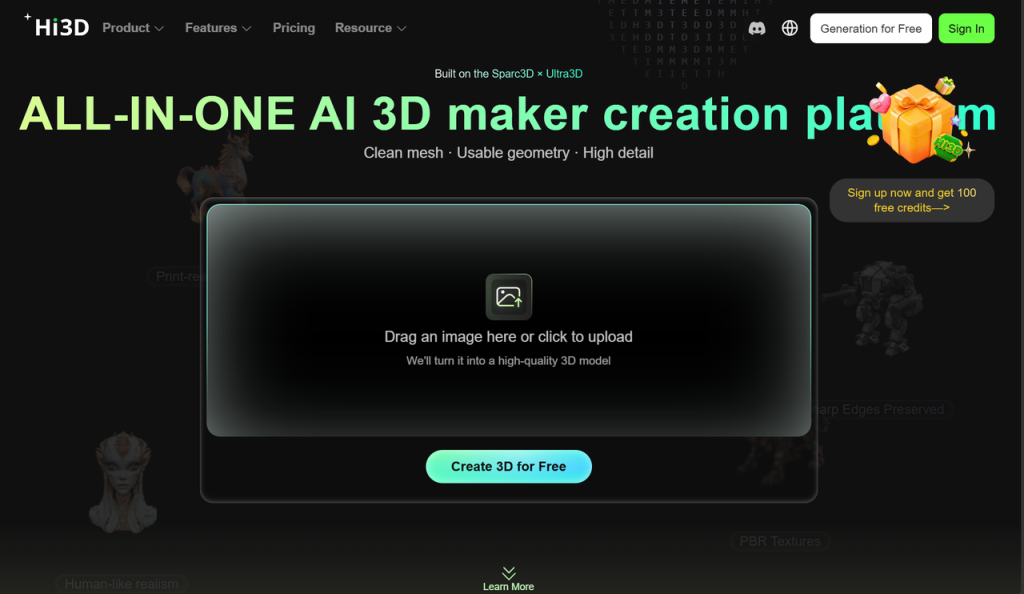
3D printing is gradually becoming an important part of modern creation, changing how people design, customize, and produce physical objects. From personalized collectibles and creative projects to educational models and product prototypes, 3D printing allows more ideas to move from digital screens into the real world. As more individuals and industries begin exploring 3D printing, the challenge is no longer only about how to manufacture an object, but also about how to create high-quality 3D models efficiently before production begins.
The development of AI 3D technology is helping solve this challenge by reducing the technical barriers between ideas and usable 3D assets. Traditional modeling workflows often require professional skills, complex software, and significant time investment, making it difficult for many creators to quickly transform concepts into models.
Hi3D is designed to provide a more accessible AI 3D creation workflow. Through AI-powered model generation, texture processing, and printing preparation tools, Hi3D helps users transform ideas into usable 3D assets more easily. With the release of Hi3D V3.0, the platform further improves reconstruction accuracy, structural stability, and production capabilities, making AI-generated models more suitable for practical applications.
1. Making 3D Creation More Accessible: From Creative Ideas to Usable Models
Different creators face different challenges throughout the 3D creation process. Beginners may find professional modeling software difficult to learn, designers may need faster methods to test creative concepts, and makers may spend significant time preparing models before printing.
Hi3D focuses on reducing these barriers by simplifying the early creation process and supporting the transition from imagination to physical production. Instead of requiring users to begin with complicated modeling tools, Hi3D allows creators to start with images or descriptions and gradually develop complete 3D assets.
1.1 Turning Images and Text Descriptions into 3D Models
For many creators, the first step of a project starts with a visual reference instead of an existing 3D file. A character image, product picture, artwork, or design sketch may contain the core idea, but transforming these references into three-dimensional models traditionally requires professional modeling knowledge and considerable time.
Hi3D supports image to 3D model AI capabilities, helping users convert two-dimensional visual information into three-dimensional models. By analyzing image content and reconstructing object structures, Hi3D provides a more efficient way to create initial 3D assets from existing references.
This workflow is useful for different types of creators. Beginners can use images as a starting point to explore 3D creation without needing advanced modeling experience. Designers can use AI-generated models as an early foundation for concept development, reducing repetitive manual work during the initial design stage.
Hi3D also supports text-based generation, allowing users to describe objects, characters, or creative ideas and use AI assistance to create an initial model. This approach provides more flexibility for users who want to explore concepts before developing detailed designs.
For creators who want a simpler way to enter AI-powered 3D creation, Hi3D provides a practical workflow similar to an AI 3D model maker, helping users move from creative inspiration to digital assets with fewer technical barriers.

1.2 Preparing AI Models for Real Printing Applications
Generating a model is only one part of the complete 3D workflow. When users want to transform digital assets into physical objects, they often need to consider additional challenges such as color management, model size, part separation, and printing preparation.
Hi3D provides multiple tools designed around these practical requirements. Multi-color printing helps users transform AI-generated textured models into printable multi-color objects, creating a closer connection between digital appearance and physical output.
Smart arrangement helps reduce preparation work before slicing. After models are generated or divided into parts, Hi3D can assist users with arranging objects on the build plate, improving workflow efficiency before printing.
Split-for-printing provides additional support for complex models. It can separate complete models into printable components, create watertight parts, and generate assembly connectors, making larger or multi-part objects easier to produce.

1.3 Improving Visual Quality Through AI Texture Processing
While geometry determines the basic structure of a model, surface details strongly influence the final appearance. Texture quality is especially important for collectibles, artistic models, product demonstrations, and other visually focused applications.
Hi3D supports AI texturing features that help users improve the appearance of generated assets. By using AI-assisted texture processing, creators can enhance surface details without manually creating every texture element.
Hi3D V3.0 further improves texture capability by supporting up to 8K texture output and upgrading its self-developed UV completion algorithm. These improvements enhance pattern clarity, color transitions, and fine texture recognition, helping models maintain better visual quality.

2. Hi3D V3.0: A New Generation of AI 3D Models Built for Real-World Use
As AI 3D technology develops, the definition of a useful 3D model is changing. A model that only looks correct from one perspective is no longer enough for many practical applications. Users need assets that maintain details, preserve structures, and continue smoothly into editing, printing, and production workflows.
Hi3D V3.0 focuses on these practical requirements. The upgrade is designed to reduce the manual adjustments required after AI generation and help AI-created models become more suitable for real production environments.
2.1 Core Upgrade: Higher Accuracy with 2048³ Reconstruction
One of the most significant improvements in Hi3D V3.0 is its enhanced geometry reconstruction capability. The new version increases reconstruction resolution from 1536³ to 2048³ voxel-level resolution, becoming the first commercially available AI 3D model with 2048³ ultra-high-precision reconstruction capability.
Higher reconstruction accuracy allows more information to be preserved during the generation process. Details that may previously have been simplified, such as small mechanical structures, engraved patterns, text edges, and complex surface features, can now achieve clearer reconstruction.
The improved geometry representation also enhances the reconstruction of small components, thin structures, shallow details, and complex shapes. This allows AI-generated models to achieve better completeness and refinement when handling detailed objects.
For designers and makers, higher precision means generated models can better match creative intentions and require fewer manual corrections before further use.
2.2 More Reliable Structures Through Improved AI Understanding
One of the biggest challenges in AI 3D generation is dealing with information that cannot be directly seen. When only one image is provided, AI needs to infer hidden surfaces, back-side structures, and relationships between different parts.
Hi3D V3.0 improves cross-view structure reasoning by strengthening its ability to understand multiple views, occluded areas, and complex object relationships. This helps maintain better structural consistency from different perspectives, especially for objects with complicated shapes or overlapping components.
This improvement is important because practical 3D applications often require models to remain reliable beyond the original viewing angle. Whether for printing, digital presentation, or further design development, structural stability directly affects usability.
3. Hi3D V3.0 Workflow Improvements: Connecting AI Generation with Production
A major challenge for AI 3D technology is not only generating attractive models but also making those models easier to use after creation. A complete workflow needs to support the transition from digital assets to physical production.
Hi3D V3.0 continues improving this connection by introducing workflow features focused on real printing scenarios.
3.1 Smart Split-for-Printing for Flexible Manufacturing
Complex models often create difficulties during printing. Large objects, detailed figures, and multi-part designs may require additional preparation before they can be manufactured successfully.
Hi3D V3.0 improves this process through split-for-printing features. The function can transform complete models into separate printable components while supporting automatic part separation, watertight mesh repair, and connector generation.
These improvements reduce manual preparation work and make it easier for creators to produce larger or more complicated objects.
3.2 Multi-Color Printing and Smart Arrangement
Color expression and printing organization are also important parts of the production process.
Hi3D V3.0 supports multi-color printing workflows, helping users preserve richer visual information when transforming digital models into physical objects. Smart arrangement assists users in organizing parts on the build plate and saving recommended printing settings through 3MF export.
Together, these workflow improvements create a smoother connection between AI-generated models and actual printing processes.
4. Hi3D V3.0 Evolution: Building a Complete AI 3D Creation System
Hi3D V3.0 represents the latest stage of continuous development. Instead of focusing on a single function, Hi3D has gradually expanded from improving model generation quality to supporting the complete journey from creative ideas to printable objects.
4.1 Version Development: Improving AI 3D Creation Step by Step
Hi3D V1.0 introduced a commercially available image-to-3D model with 1536³ voxel-level resolution, improving fine structure reconstruction. Hi3D V2.0 further developed geometry and texture integration, improved hidden structure completion, and created a more complete generation workflow. Hi3D V3.0 continues this direction by improving geometry accuracy, complex structure processing, texture quality, and printing-related features.
The evolution from V1.0 to V3.0 shows how AI 3D creation is moving beyond simple model generation. The focus is gradually shifting toward creating assets that can be edited, displayed, printed, and applied in different scenarios.
4.2 Industry Applications: Supporting More Fields with 3D Content
The demand for high-quality 3D assets continues to grow across industries including 3D printing, game and film production, digital art, jewelry design, collectibles, cultural exhibitions, education, e-commerce content, and industrial design.
Although these industries have different workflows, they share similar needs for reliable structures, clear details, and flexible usability.
Hi3D V3.0 aims to lower the barrier to high-quality 3D content creation, helping more users access editable, display-ready, and printable 3D assets.
For creators looking for an efficient 3D model maker AI solution, Hi3D V3.0 provides a workflow that connects creativity, AI assistance, and real-world production.
5. Experience Hi3D V3.0 Free for 48 Hours
To allow more users to experience the latest AI 3D technology, Hi3D will open a limited-time free experience of Hi3D V3.0 from August 19, 2026, 00:00 to August 20, 2026, 24:00 (Beijing Time). During this period, users can use the Hi3D V3.0 model without generation limits.
This 48-hour experience provides an opportunity to explore upgraded 2048³ high-precision model generation, improved texture quality, and production-focused workflow features.
Whether you are a beginner exploring 3D creation, a designer developing new concepts, or a maker preparing physical models, Hi3D V3.0 provides a simpler way to transform digital ideas into real-world creations.