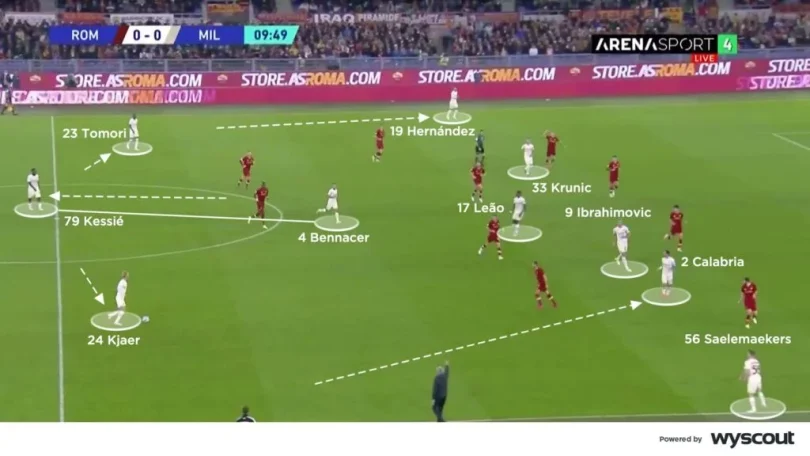
The double pivot is one of modern football’s most debated tactical concepts — a midfield configuration built around two holding players operating in parallel rather than in a traditional single-pivot structure with one deep midfielder behind a more advanced partner. Understanding what the double pivot in football actually means, how it functions structurally, and when it provides a tactical advantage over alternatives requires examining the positional geometry, defensive coverage, and build-up responsibilities that make the arrangement distinct from superficially similar midfield setups. Sports analysis, tactical breakdowns, and live match coverage across top European leagues are available through dedicated platforms — a quality betting app covering major football competitions tracks formation data and positional statistics that reveal how frequently elite teams deploy double pivot structures and under what tactical conditions.
A double pivot in football places two central midfielders at the same horizontal depth in front of the defensive line — creating a flat two-man screen rather than a staggered 6-8 or 8-10 pairing where one player sits deeper and the other operates higher. The term “pivot” derives from the individual role of a single holding midfielder who pivots between defensive coverage and ball distribution; “double” refers to the duplication of this function across two players sharing the same spatial zone. The double pivot football structure appears most commonly within 4-2-3-1 and 4-2-2-2 formations but can be deployed within any system that designates two midfielders to the holding layer simultaneously.
How the Double Pivot Differs From a Single Pivot
The distinction between single and double pivot configurations is structural rather than cosmetic — the two arrangements produce fundamentally different defensive coverage, passing networks, and transition dynamics.
Single pivot structure places one midfielder at the base of the midfield — typically numbered as a 6 in positional terminology — with all other midfielders operating in higher or wider positions. The single pivot is responsible for covering the space in front of the defensive line, intercepting transitions, and serving as the primary distribution point from deep positions. The single pivot’s effectiveness depends heavily on the individual player’s range, reading of the game, and physical capacity to cover large amounts of ground independently.
Double pivot structure divides these responsibilities between two players occupying parallel positions at the same depth. Neither player is required to cover the full width of the defensive zone — each takes responsibility for a defined half, with the partnership providing mutual coverage when one player moves forward or wide to press or receive. The two-player structure creates redundancy: if one pivot is drawn out of position, the other maintains the base.
The trade-off is arithmetic — deploying two players in the holding layer removes one player from higher positions. A team using a double pivot in a 4-2-3-1 has one attacking midfielder behind the striker; a team using a single pivot in a 4-3-3 has two midfielders available in higher, more attacking zones. This constraint is the central reason coaches choose between the configurations based on the opposition, the team’s defensive requirements, and the available personnel.
Structural Functions of the Double Pivot
Defensive screening is the primary function. Two players positioned horizontally across the base of midfield create a coverage barrier that is geometrically harder to play through than a single player. Passes aimed at the space between the defensive line and the midfield — the “half space” that attacking teams target — must navigate two potential interceptors rather than one.
Coverage asymmetry in transition is addressed more effectively by a double pivot than a single pivot. When possession is lost in the attacking half and the opposition launches a counter-attack, a single pivot may be caught out of position if the team has pushed forward aggressively. Two pivot players provide structural insurance — even if one has advanced, the other maintains the defensive base, ensuring the team does not transition into a numerically compromised defensive shape instantly.
Build-up geometry is altered significantly. Two deep midfielders provide two simultaneous short-pass options for centre-backs under pressure — the receiving pivot can redistribute while the non-receiving pivot maintains width and depth as the secondary option. Against high-pressing opponents, the double pivot provides the defensive line with more immediate release valves in closer proximity than a single deep midfielder can offer.
Positional rotation between the two pivots allows tactical flexibility within the structure. One pivot can advance to support attacking phases — effectively creating a 4-1-4-1 shape in possession — while the other maintains the holding position. The rotation can reverse on the next possession phase, creating unpredictability in which pivot advances without permanently committing to a single-pivot arrangement.
When Teams Deploy Double Pivot Football
| Match Situation | Reason for Double Pivot Selection | Alternative Considered |
| Facing a technically superior opponent | Increased defensive midfield screen | Single pivot with one advanced CM |
| Home team, protecting a lead | Structural stability over attacking ambition | Pushing one pivot higher |
| Away fixture, cautious approach | Defensive coverage priority | Three-man midfield with one pivot |
| Opposition with dangerous counter-attack | Transition coverage requirement | High-press single pivot structure |
| Opponent with dangerous #10 | Double screen neutralises the playmaker’s space | Man-marking alternative |
| Own squad lacks defensive depth | Covers technical limitations with structural coverage | Single high-quality pivot |
| High-intensity pressing game | Two players covering press triggers simultaneously | Single pivot high-press system |
The selection of double pivot football is rarely a permanent feature of a team’s identity — it is more commonly a contextual adjustment. Teams that predominantly use a single pivot in league competition may shift to a double pivot for specific away fixtures against technically dangerous opponents, or for knockout matches where defensive solidity outweighs the offensive output cost of an additional holding player.
Player Profiles in a Double Pivot Partnership
The double pivot works most effectively when the two players are complementary rather than identical in profile. A partnership of two players with the same dominant attribute — two pure ball-winners, for instance — creates coverage in one dimension while leaving the other underserved.
The ball-winner profile contributes physical defensive capacity — aerial presence, tackling, blocking through-balls, and winning second balls in the defensive zone. The ball-winner partner provides the pivot with aggressive press triggers and the capacity to recover defensive errors through physical intervention.
The distributor profile contributes technical quality in possession — range of passing, composure under pressure, and the ability to switch play from deep positions to exploit defensive shape. The distributor partner ensures the double pivot does not become a dead end for possession — the two-player base must circulate the ball efficiently, not simply hold it.
The hybrid profile — a player capable of performing both functions adequately — allows coaches to field a double pivot without the complementary differentiation, but typically at the cost of excellence in either dimension. Two hybrid pivots produce reliability without the tactical ceiling created by a genuinely complementary pairing.
Physical coordination between pivot partners involves synchronised positioning that prevents both players from moving in the same direction simultaneously. If both pivots press aggressively to the same side, the space vacated behind them is the same space the opposition will exploit in transition — the double pivot’s defensive value depends on one player holding position while the other engages.
Double Pivot in Possession: Build-Up Patterns
The double pivot’s role in build-up play is as important as its defensive function — teams that deploy two holding midfielders but derive no positional value from them in possession pay a significant opportunity cost without equivalent benefit.
Staggered positioning within the double pivot creates passing angles that differ from a flat horizontal alignment. One pivot positions slightly higher and wider while the other sits slightly deeper and central — the stagger creates two distinct passing lanes from the defensive line rather than two players in the same passing window.
Third-man combinations through the double pivot involve the defensive line playing into one pivot, who immediately plays into the advancing second pivot, who distributes forward. This three-touch sequence progresses the ball through the press without the defensive line being required to play directly into tight central spaces — the pivots act as relays that accelerate ball progression without individual players needing to carry through pressure.
Inverted full-back interaction with the double pivot has become increasingly significant in modern high-possession systems. When full-backs tuck inside to support midfield build-up, the double pivot must adjust its horizontal positioning to maintain coverage rather than creating overcrowding in the same zones. Effective double pivot football requires the two holding midfielders to read the full-backs’ movements and create complementary positioning that gives the team numerical superiority in the build-up phase without structural gaps in transition.
Common Tactical Problems With the Double Pivot
| Tactical Problem | Cause | Consequence |
| Overcrowding in central zones | Both pivots and full-backs occupying same space | Reduced passing lanes; predictable build-up |
| Defensive gaps between pivots | Poor synchronisation; simultaneous forward movement | Opponents exploit space in half-spaces |
| Limited vertical threat from midfield | Two holding players rarely advance together | Opposition defensive line remains compact |
| Isolation of the #10 behind the striker | Only one player between pivot and attack | Reduced midfield connections for advanced players |
| Counter-press vulnerability | Both pivots advance, defensive line exposed | Rapid opposition transitions into space behind |
| Loss of width in midfield | Pivots centralise; no midfield width provided | Opposition defends narrowly without concern for wide midfield threat |
The most common structural problem with double pivot football is the creation of a three-section team — defence, double pivot, and attack — without sufficient connection between layers. When the two pivots sit deeply and the attacking players maintain high positions, the space between the second layer and the third is exploited by a compact defensive opponent who simply allows the pivots to hold the ball without pressure, knowing the distance to goal is too great for a single pass to threaten effectively.
The solution involves disciplined positional rotation — one pivot advancing while the other holds — and coordinated movement from the attacking players to stay connected to the pivots. Teams that resolve the disconnection problem typically produce the most stable version of double pivot football: a compact defensive base combined with efficient ball circulation that creates attacking situations without compromising the structural integrity of the defensive screen.
Double Pivot Versus Three-Man Midfield
The primary tactical alternative to the double pivot in possession-oriented systems is the three-man midfield — one holding player behind two more advanced central midfielders — which provides greater midfield presence at the cost of defensive coverage width.
A three-man midfield with a single pivot offers more bodies between the lines, more passing connections in the middle third, and a greater capacity to overload the opposition midfield numerically. The single pivot’s defensive burden is higher, and the transition vulnerability increases when the advanced midfielders are caught in possession.
The choice between double pivot football and a three-man midfield is ultimately determined by the opponent’s attacking structure. Against teams with two central attacking midfielders or a creative number 10 operating between the lines, a double pivot provides two players to cover these threats; against teams with two wide forwards and a lone striker, a three-man midfield may provide sufficient defensive coverage while offering more in possession.
High-level coaching staff increasingly treat the double pivot not as a fixed formation preference but as one tool within a flexible system — deploying it situationally within the same game rather than maintaining it across the full 90 minutes. The capacity to shift between a double pivot in defensive phases and a single pivot in possession phases, within the same match, represents the most sophisticated application of the concept in contemporary professional football.